Disclaimer: The information provided in this article is for informational and educational purposes only and does not constitute financial, investment, or trading advice. Always conduct your own research before making any investment decisions.
Understanding XRP Wallet Security is vital for any crypto investor navigating the rapidly evolving digital asset landscape today. Ripple (XRP) is no longer just an asset you buy and sell on an exchange — it serves as the foundation for a rapidly growing ecosystem known as the XRP Ledger (XRPL). With a wide range of DeFi, NFT, and smart contract projects actively building on XRPL, demand is surging for managing XRP directly through self-custody wallets while ensuring top-tier XRP Wallet Security.
In this comprehensive guide, we will take a complete look at the standout projects driving the XRPL ecosystem, along with the essential wallet types and security practices needed to keep your XRP safe from both online and offline security risks.

1. Why Ecosystem Growth Makes XRP Wallet Security Crucial
As mainnet infrastructure evolves, leaving digital assets on a centralized exchange introduces counterparty risks, withdrawal halts, and account freeze dangers. Transferring assets to personal non-custodial wallets grants full ownership, but it also places the burden of protection entirely on the user. Understanding how the XRPL functions and maintaining strict XRP Wallet Security protocols is the very first step toward safe, long-term asset management.
Centralized exchanges maintain control of your private keys. If an exchange experiences liquidity shortages or regulatory shutdowns, your funds could be locked indefinitely. By transitioning to self-custody, robust XRP Wallet Security ensures that you remain the sole controller of your financial assets.
2. Must-Know Core Projects in the XRPL Ecosystem
The XRPL ecosystem is interconnected with various groundbreaking projects designed to maximize the speed, utility, and flexibility of the underlying financial network.
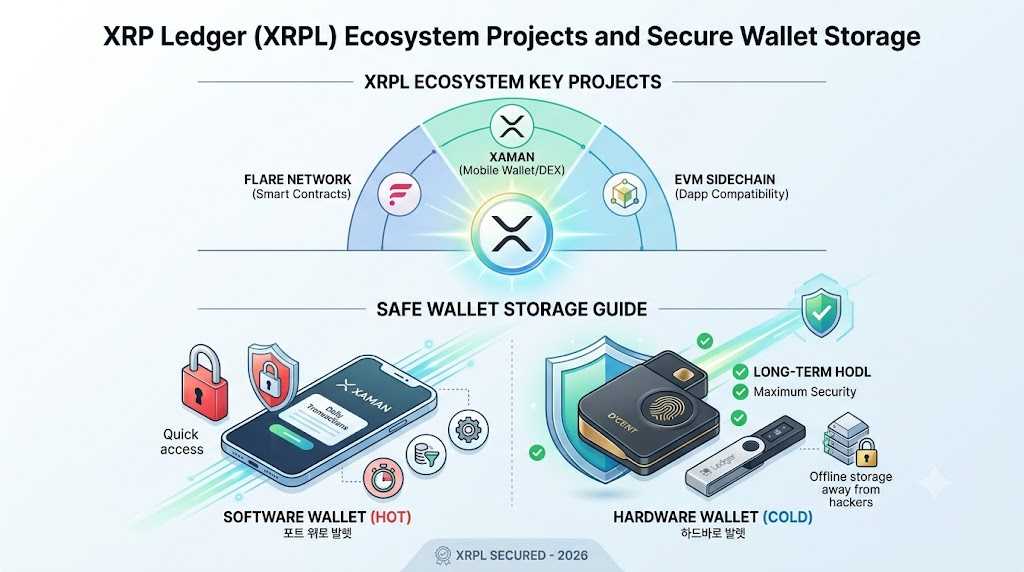
1) Flare Network
A prominent Layer 1 project that brings advanced smart contract functionality to the XRPL. It enables XRP holders to participate in decentralized finance (DeFi) protocols and earn yield through cross-chain interoperability while preserving liquidity.
2) Xaman (formerly Xumm)
The most widely adopted mobile self-custodial wallet within the XRPL community. Beyond simple token transfers, Xaman provides seamless access to XRPL’s native decentralized exchange (DEX) and various dApps built on the ledger while upholding individual XRP Wallet Security standards.
3) Sidechains & Layer 2 Solutions (EVM Sidechain)
By implementing Ethereum Virtual Machine (EVM) compatibility, developers can easily port Ethereum-based smart contracts and decentralized applications straight into the XRPL environment, drastically expanding its decentralized utility.
3. How to Choose a Safe Wallet for XRP Wallet Security
There is a well-known axiom in cryptocurrency: “Not your keys, not your coins.” Selecting the right wallet depends on whether you prioritize daily utility or long-term XRP Wallet Security.
- Software Wallet (Hot Wallet – Xaman): Offers high convenience by allowing users to execute transactions and interact with XRPL applications directly from a smartphone. However, constant internet connectivity requires strict management of your secret recovery phrase against phishing scams and mobile malware.
- Hardware Wallet (Cold Wallet – D’CENT, Ledger): Provides the highest standard of XRP Wallet Security. Private keys remain completely isolated inside an offline hardware chip, virtually eliminating online hacking threats. It is essential for long-term storage, though it incurs hardware purchase costs and requires physical connection to sign transactions.
4. Balancing Security with Ecosystem Utility
As the Ripple ecosystem expands, the ways to utilize XRP will continue to increase. However, proactive security practices must always remain your top priority:
- Divide your asset allocation strategy: Use a hot wallet (Xaman) for small-scale active utility or DEX trading, and keep a cold wallet (Ledger/D’CENT) for primary holdings to optimize overall XRP Wallet Security.
- Offline Recovery Seed Storage: Never store your recovery phrase in digital formats, such as smartphone photos, cloud notes, or email drafts. Write it down on paper or stamp it onto steel, and keep it in a secure location.
- Verify Wallet Destination Tags: When sending XRP to centralized exchanges, always double-check the Destination Tag requirement to prevent permanent fund loss.
5. Frequently Asked Questions About XRP Wallet Security
Q1: What happens if I lose my hardware wallet device?
As long as you have your offline secret recovery phrase securely written down, your funds are safe. You can easily restore your account and maintain full XRP Wallet Security by importing your recovery phrase into a new wallet device.
Q2: Why does the XRP Ledger reserve 10 XRP when activating a new wallet?
The XRPL implements an account reserve requirement (currently 10 XRP) to prevent malicious actors from spamming the ledger with empty accounts. This structural feature significantly enhances overall network efficiency and XRP Wallet Security.
To learn more about macro market perspectives, feel free to check our Ripple XRP Outlook for 2026.