Disclaimer: All information provided in this post is for general informational and educational purposes only, and should not be construed as financial, investment, or trading advice under any circumstances. Investors bear full responsibility for their own investment decisions.
The Stacks Nakamoto upgrade Bitcoin L2 architecture is transforming how the Bitcoin (BTC) ecosystem moves beyond a simple store of value, entering a competitive race to expand smart contract capability and decentralized finance via scaling solutions. You can track real-time market data, TVL metrics, and crypto trends on CoinMarketCap.
At the forefront of this movement is Stacks (STX) — a leading solution that enables smart contract execution while leveraging Bitcoin’s robust security model. Following the deployment of its Stacks Nakamoto upgrade Bitcoin L2 framework, Stacks has resolved key historical performance bottlenecks to unlock scalable Bitcoin DeFi (BTCFi). Check out our latest Web3 research guides for deeper layer-2 analysis.
In this guide, we break down the key technical upgrades introduced by Nakamoto, how Stacks compares before and after the release, and the fundamental catalysts driving the STX token ecosystem.
1. 3 Key Changes Brought by the Nakamoto Upgrade
The original Stacks network faced transaction latency limits because block production was tied directly to Bitcoin’s 10-minute block times. The deployment of the Stacks Nakamoto upgrade Bitcoin L2 framework decoupled execution cycles to deliver high-throughput performance without compromising base-layer security. Official documentation and whitepapers are accessible at the Stacks Official Platform Portal.
Key Technical Innovations
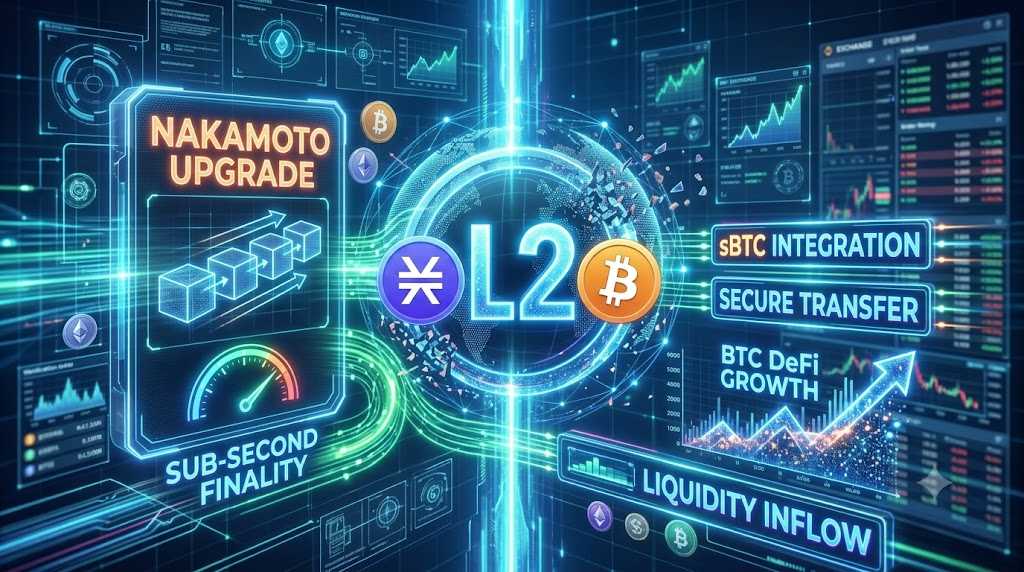
Through the Stacks Nakamoto upgrade Bitcoin L2 implementation, the network achieved three major structural milestones:
- Sub-Second Transaction Speeds: By separating Stacks block production from Bitcoin mining cycles, transaction execution times dropped from minutes to under 5 seconds, providing a responsive UX for dApps.
- 100% Bitcoin Security Finality: Once a transaction block is finalized on Stacks, it achieves complete settlement backed by the full hash power and immutability of the Bitcoin network.
- Launch of sBTC (Trust-Minimized BTC Peg): sBTC provides a 1:1 Bitcoin-backed asset operating on Stacks without relying on centralized custodians, enabling native BTC liquidity to flow directly into DeFi applications.
2. Stacks Before vs. After the Nakamoto Upgrade
Understanding how the Stacks Nakamoto upgrade Bitcoin L2 transition affects everyday usability is vital for developers and traders. The table below summarizes the architectural and operational shifts across the network following the upgrade.
| Category | Original Stacks (Stacks 2.0) | After Nakamoto Upgrade |
|---|---|---|
| Block Production Speed | Tied to Bitcoin block time (~10 minutes) | Fast ~5-second block times for high-speed UX |
| Network Finality & Security | Relied in part on separate Stacks signers | 100% finality backed by Bitcoin base-layer hash power |
| BTC Asset Utility | Limited mostly to wrapped / custodial asset formats | Direct on-chain BTCFi integration via 1:1 pegged sBTC |
| Ecosystem Scalability | Latency constrained complex dApp performance | Optimized environment for high-performance DEXs, lending, and RWAs |
3. Bullish Catalysts and Key Metrics for STX
As an active protocol benefiting from the Stacks Nakamoto upgrade Bitcoin L2 rollout, demand for STX is tightly connected to the broader expansion of Bitcoin on-chain financial infrastructure.
- Expansion of the BTCFi Addressable Market: If even 1–2% of Bitcoin’s circulating market cap transitions into on-chain yield strategies via Stacks L2, Total Value Locked (TVL) could scale significantly, expanding network fee revenue.
- Post-Halving Yield Demand: Driven by the Stacks Nakamoto upgrade Bitcoin L2 efficiency gains, miners and capital allocators increasingly seek secondary yield channels and transaction fee capture post-halving.
- Key Execution Indicators to Watch: Track sustained growth in ecosystem TVL, active sBTC mint volume, and daily contract executions on major Stacks-native DEXs and money markets.
4. Frequently Asked Questions (FAQ)
Q1: How does the Stacks Nakamoto upgrade Bitcoin L2 model support sBTC?
Unlike WBTC, which relies on centralized custodians and third-party merchants, sBTC operating within the Stacks Nakamoto upgrade Bitcoin L2 framework uses a decentralized, trust-minimized network of signers incentive-aligned by Proof-of-Transfer.
Q2: What is Proof-of-Transfer (PoX) in Stacks?
Proof-of-Transfer (PoX) is the consensus mechanism where Stacks miners commit native BTC to participate in block production, and STX holders who stack (lock) their tokens earn native Bitcoin yields.
Q3: Why are faster block times critical for Bitcoin L2s?
Bitcoin’s 10-minute block interval makes real-time trading and interactive dApp usage impractical. Fast sub-5 second blocks allow DEX order books and lending platforms to function smoothly like modern web applications.
💡 Summary & Strategic Takeaways
The successful deployment of the Stacks Nakamoto upgrade Bitcoin L2 represents a structural shift for Stacks, pairing Ethereum-style smart contract versatility with Bitcoin’s settlement security.
- What to Monitor: Watch adoption trends across core Stacks money markets, automated market makers (AMMs), and collateralized sBTC pools powered by the Stacks Nakamoto upgrade Bitcoin L2 network.
- Long-Term Outlook: As one of the most established L2 platforms servicing the growing Bitcoin economy, STX remains a key infrastructure asset to track in the expanding BTCFi space.