Disclaimer: All information provided in this post is for general informational and educational purposes only, and should not be construed as financial, investment, or trading advice under any circumstances. Investors bear full responsibility for their own investment decisions.
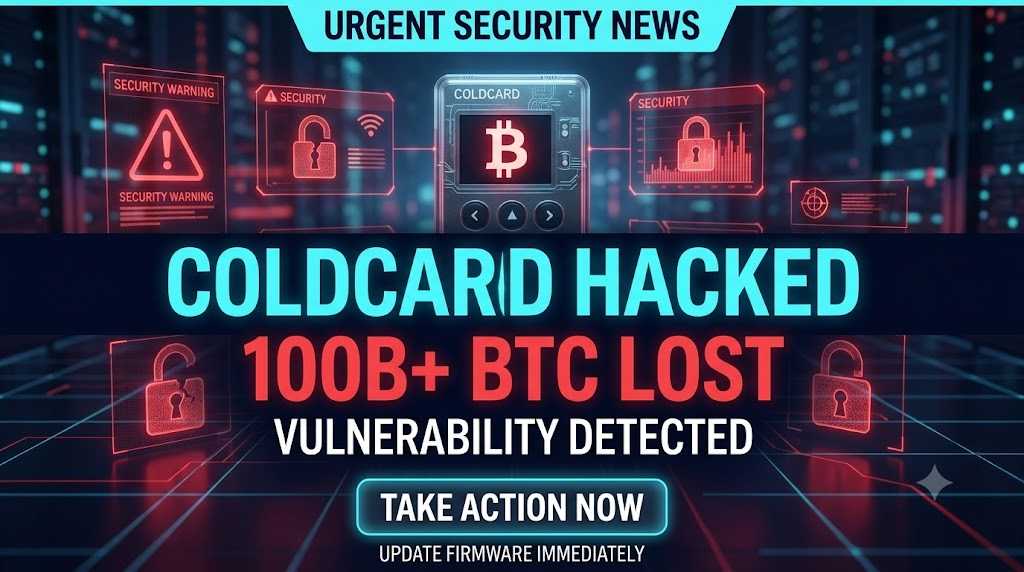
Coldcard vulnerability reports have shocked the self-custody ecosystem after security researchers discovered a severe entropy (random number generation) flaw in one of the Bitcoin industry’s most trusted hardware wallets. Long regarded as an air-gapped security sanctuary, certain firmware versions generated private keys with significantly reduced mathematical randomness, allowing attackers to brute-force keys and drain funds remotely.
According to security advisories from manufacturer Coinkite, the flaw bypassed hardware True Random Number Generators (TRNG) during initial seed setup. This allowed malicious actors to reverse-engineer the underlying key space without ever gaining physical access to the devices.
In this comprehensive guide, we analyze the root cause of the Coldcard vulnerability, evaluate the hidden blind spots of hardware wallet security, and outline 3 critical response steps to safeguard your Bitcoin holdings.
1. The Full Story: Over 1,300 BTC Drained From Coldcard Wallets
This exploit underscores a fundamental truth in cryptography: an offline, air-gapped device cannot protect digital assets if the underlying mathematics used to generate its seed phrase—its entropy—is compromised.
How the Entropy Flaw Was Exploited
- Flawed Entropy Generation: Traced back to firmware updates introduced in March 2021 (v4.0.0), affected devices bypassed the internal hardware TRNG during seed creation. Effective entropy on Mk3 devices dropped from 128 bits down to roughly 40 bits.
- Brute-Force Key Enumeration: With randomness reduced to approximately 1.1 trillion total possibilities, attackers calculated candidate private keys on high-performance GPUs, derived on-chain addresses, and silently swept funds.
- Multi-Million-Dollar On-Chain Loss: On-chain telemetry indicates over 1,367 BTC (valued between $38M and $89M) was drained from more than 4,500 vulnerable wallet addresses in automated sweeps.
2. The Hidden Blind Spots in Hardware Wallet Security
For years, standard self-custody advice was straightforward: “Buy a hardware wallet, keep it off the internet, and your keys are safe.” The Coldcard vulnerability highlights critical nuances that every self-custody investor must understand:
Key Security Nuances
- Hardware Isolation vs. Mathematical Integrity: Air-gaps and offline signing prevent remote malware from stealing existing keys, but they offer zero protection if seed phrases lacked randomness at the exact moment of creation.
- Open-Source Audits Are Necessary, But Not Infallible: Open-source code allows public scrutiny, but complex cryptographic bugs can still lie hidden for years before being weaponized. For developer standards on key generation, consult Bitcoin.org documentation.
- Firmware Updates Cannot Fix Weak Seeds Retroactively: Flashing new firmware fixes device software for future seed generation, but it cannot retroactively inject missing entropy into an already-compromised seed phrase.
3. Comparison Table: Flawed Entropy vs. Secure Seed Generation
To understand how the Coldcard vulnerability impacted seed randomness and how to secure your wallet moving forward, review the comparison table below:
| Security Parameter | Vulnerable Firmware State (v4.0.0+) | Secure Seed Configuration |
|---|---|---|
| Entropy Source | Bypassed TRNG (~40 bits of effective entropy). | Full hardware TRNG + 50+ manual dice rolls (128–256 bits). |
| BIP-39 Passphrase Defense | Not used (pure single-sig seed vulnerable to brute-force). | Strong 25th-word passphrase adds independent entropy. |
| Brute-Force Resistance | Low (~1.1 trillion key combinations; GPU solvable). | Mathematically impossible ($2^{128}+$ combinations). |
| Remediation Strategy | Updating firmware alone is insufficient. | Update firmware AND migrate funds to a new seed. |
4. Action Plan: 5 Urgent Steps for Bitcoin & Hardware Wallet Holders
If you or your organization utilize Coldcard or similar hardware signing devices, follow this response protocol immediately:
- Check Your Seed Generation Method: According to official Coinkite advisories, seeds created with a strong BIP-39 Passphrase (the “25th word”) or generated using 50+ manual dice rolls provided independent randomness and remained safe.
- Update to Patched Firmware: Download and verify official firmware updates (v5.6.0 for Mk4/Mk5, v1.5.0Q for Coldcard Q) through verified vendor channels.
- Generate a Fresh Seed and Migrate Funds: If your seed was generated on vulnerable single-sig firmware without dice rolls or passphrases, create a new seed on updated firmware and carefully transfer your funds. For deeper security insights, explore our latest crypto market updates.
- Beware of Phishing “Seed Checker” Scams: Never enter your seed phrase or private keys into any website or online tool claiming to check if your wallet is affected.
- Implement Multi-Vendor Multisig: For high-value treasury reserves, implement a multisignature (multisig) vault combining hardware signers from different manufacturers (e.g., Coldcard + Trezor + Ledger) to eliminate single points of failure.
💡 Summary and Conclusion
The recent Coldcard vulnerability serves as a stark reminder that true self-custody security requires rigorous mathematical integrity across the entire key lifecycle.
By combining hardware TRNGs with user-supplied entropy (dice rolls), strong BIP-39 passphrases, and multi-vendor multisig setups, investors can ensure institutional-grade protection against both digital and mathematical attack vectors.