Disclaimer: All information provided in this post is for general informational and educational purposes only, and should not be construed as financial, investment, or trading advice under any circumstances. Investors bear full responsibility for their own investment decisions.
The intense BIP-110 Governance Debate has quickly emerged as a central focal point for institutional investors and protocol developers as August 2026 gets underway. The crypto market is facing a critical turning point that extends far beyond mere short-term price action — one heavily shaped by internal network governance conflicts, heightened security risks, and the rapid expansion of AI-driven payment rails.
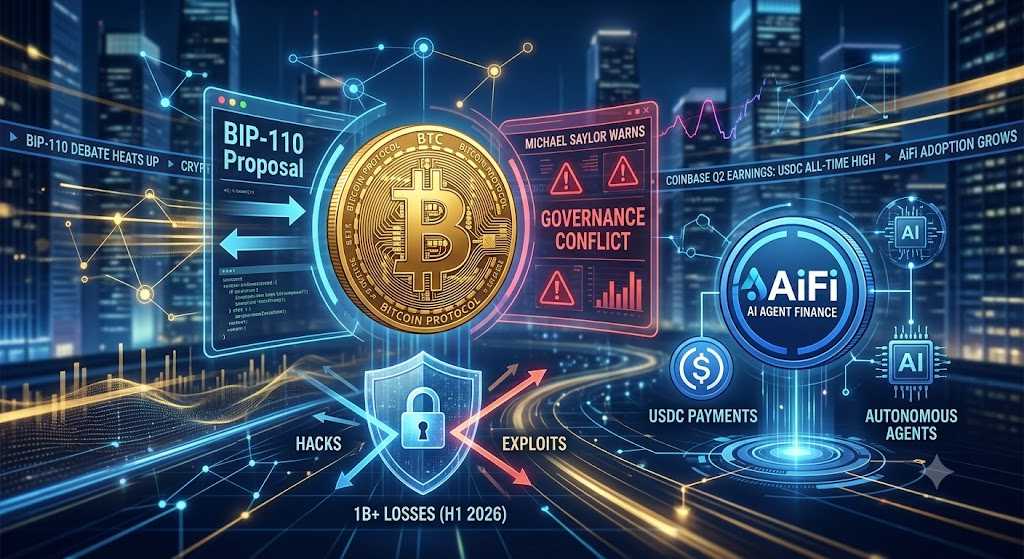
Tensions have escalated surrounding proposed base-layer protocol updates, sparking debate between core developers and major institutional miners, with MicroStrategy chairman Michael Saylor issuing a direct warning. In this comprehensive analysis, we break down how the BIP-110 Governance Debate, multi-chain security exploits, and autonomous AI payment infrastructure are shaping digital asset markets in August 2026.

1. “Don’t Touch Bitcoin’s Constitution”: The BIP-110 Governance Debate
A proposed temporary soft fork proposal known as BIP-110 has triggered significant controversy across the global Bitcoin ecosystem. The core objective of the proposal is to temporarily restrict non-financial data transactions — such as Ordinals inscriptions, BRC-20 tokens, and Runes — from occupying valuable blockchain block space.
Key Elements of the Governance Conflict
- The Intent Behind BIP-110: Proponents argue that limiting media-heavy data on-chain prevents fee spikes, preserves network throughput, and protects Bitcoin’s core function as a decentralized, peer-to-peer monetary settlement system.
- Michael Saylor’s Strong Opposition: Michael Saylor has publicly pushed back against protocol modifications, comparing Bitcoin’s underlying consensus rules to an immutable economic constitution. He warned that internal developer factions attempting to alter base-layer rules risk undermining long-term economic property rights.
- Market Implications: Without broad consensus across miners, node operators, and developer groups, the BIP-110 Governance Debate creates ongoing regulatory and technical uncertainty that is being closely monitored by institutional market participants.
2. Crypto Security Losses Surpass $1 Billion in H1 2026
According to comprehensive research published by blockchain security firm Blockaid, exploit and hack losses targeting decentralized ecosystems exceeded $1 billion in the first half of 2026.
Major Security Vectors and Key Takeaways
- Social Engineering Attacks: Highly targeted phishing campaigns and sophisticated social engineering vectors compromising multi-signature signers emerged as primary exploit paths across major DeFi protocols.
- Ecosystem Impact: Ethereum-based infrastructure suffered roughly $330 million in cumulative losses, while Solana ecosystem projects experienced around $320 million, underscoring the critical necessity of rigorous smart contract audits.
- Risk Management for Investors: Rather than leaving substantial capital in single hot wallets, institutional and retail investors must maintain strict security practices by utilizing hardware cold storage and enforcing multi-factor signature controls.
3. Growth in “AI Agent Finance (AiFi)” and Stablecoin Infrastructure
Despite macroeconomic volatility and security challenges, core on-chain liquidity infrastructure continues to expand rapidly. Coinbase’s Q2 2026 financial report highlighted record market share gains alongside average USDC balances on its platform reaching an all-time high of $20 billion.
The Convergence of AI and Blockchain Settlement
Machine-to-machine commerce between autonomous AI agents is increasingly settling via dollar-backed stablecoins, opening a brand-new operational domain for digital assets. Furthermore, autonomous AI-driven transaction activity has expanded across Layer-2 scaling networks like Base and the x402 protocol, signaling a structural shift toward real-world digital economy utility.
To understand how enterprise stablecoin settlement aligns with asset tokenization protocols, feel free to read our previous guide on RLUSD and RWA Tokenization.
💡 Market Outlook and Investor Focus
As market participants evaluate the broader impact of the BIP-110 Governance Debate, the crypto landscape in August 2026 remains anchored around three foundational drivers: rigorous base-layer protocol stability, comprehensive wallet security, and the ongoing growth of AI-driven settlement networks.
- Bitcoin (BTC): Closely track miner signaling metrics, node signaling data, and ongoing developer commentary surrounding the ongoing BIP-110 Governance Debate.
- Asset Security: Enforce strict cold storage protocols, utilize multi-sig setups, and regularly audit wallet allowance permissions across decentralized applications.
- Portfolio Allocation: Focus on blockchain projects demonstrating tangible protocol utility, active developer metrics, and seamless integration with expanding stablecoin rails.