
Disclaimer: All information provided in this post is for general informational and educational purposes only, and should not be construed as financial, investment, or trading advice under any circumstances. Investors bear full responsibility for their own investment decisions.
While Bitcoin has been dominating macroeconomic headlines, Ethereum (ETH) has achieved a major milestone in blockchain evolution through a landmark network overhaul: the Ethereum Pectra upgrade. Representing a unified combination of the Prague execution layer and Electra consensus layer updates, this hard fork introduces 11 Ethereum Improvement Proposals (EIPs) designed to revolutionize both user experience and network infrastructure.
The primary breakthrough of the Ethereum Pectra upgrade lies in its implementation of account abstraction via EIP-7702. This capability allows everyday wallet addresses to execute smart contract logic, effectively solving long-standing usability bottlenecks across Web3 applications.
In this comprehensive guide, we break down the 3 key features delivered by the Ethereum Pectra upgrade, evaluate its impact on institutional staking, and examine strategic takeaways for long-term crypto investors.
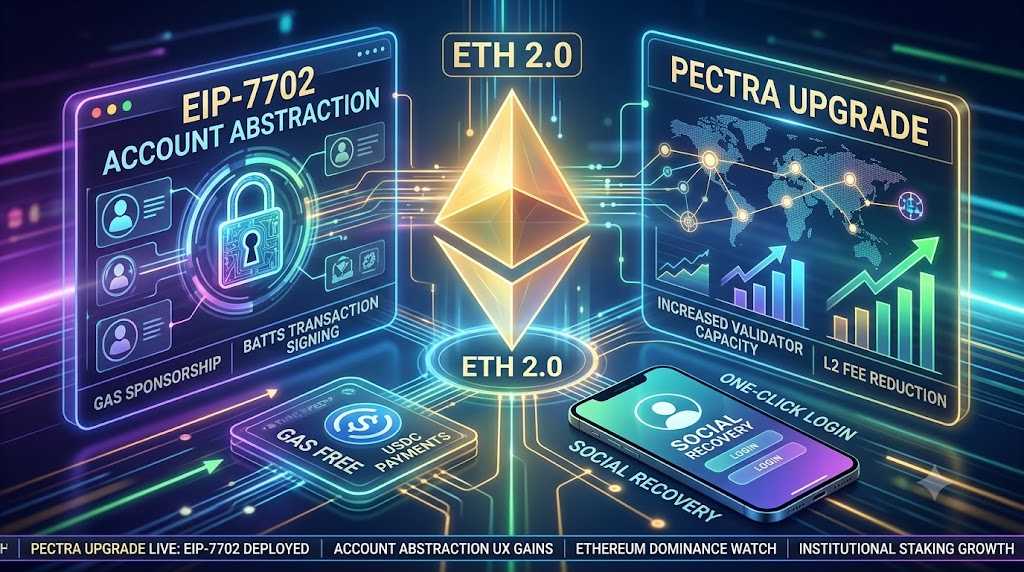
1. EIP-7702 in Ethereum Pectra Upgrade: Account Abstraction and Web3 UX
A persistent barrier to crypto adoption has been the requirement for users to hold native ETH solely to pay network transaction (gas) fees, even when trading stablecoins like USDC or USDT. EIP-7702 directly resolves this problem by allowing regular Externally Owned Accounts (EOAs)—such as software and hardware wallets—to temporarily function as smart contract accounts during a transaction.
Key Usability Innovations Unlocked by EIP-7702
- Gas Fee Abstraction: Users can pay transaction fees using non-ETH tokens already stored in their wallet, removing the necessity of maintaining a separate ETH balance.
- Sponsored Gas Transactions: Decentralized applications (dApps) and wallet providers can sponsor user gas fees completely, enabling seamless, zero-friction onboarding for new Web3 participants.
- Transaction Batching: Multi-step actions—such as approving a token allowance followed by an automated market maker swap—can now be authorized together in a single atomic signature, saving time and transaction costs.
- Flexible Account Recovery: Users can leverage web-like social recovery methods, biometric logins, and email-based key restoration rather than relying strictly on seed phrases.
2. EIP-7251 and EIP-7691: Institutional Staking and Layer-2 Scaling
Beyond consumer-facing usability enhancements, the Ethereum Pectra upgrade introduces fundamental improvements to network architecture, validator balance caps, and Layer-2 (L2) data availability.
Structural Infrastructure Upgrades
- Higher Validator Balance Cap (EIP-7251): The maximum effective balance per validator has been raised from 32 ETH to 2,048 ETH. This change allows large-scale institutional node operators to consolidate thousands of validator keys into fewer instances, significantly reducing network messaging load and lowering operational complexity.
- Expanded Layer-2 Blob Capacity (EIP-7691): The target data blob throughput per block has been doubled from 3 to 6 blobs (with a maximum limit of 9), dramatically lowering data submission costs for Layer-2 rollups such as Arbitrum, Optimism, and Base.
- Programmable Staking Exits (EIP-7002) & On-Chain Deposits (EIP-6110): Execution layer-triggerable withdrawals streamline staking management, enabling automated smart contract pools and transparent validator onboarding.
3. Ethereum Pectra Upgrade Impact: Before vs. After Comparison
To understand how the Ethereum Pectra upgrade transforms everyday transactions and node operation, review the summary comparison table below:
| Feature Category | Pre-Pectra Network State | Post-Pectra Upgrade Capability |
|---|---|---|
| Gas Fee Payment | Requires native ETH balance in wallet. | Pay gas with ERC-20 tokens (USDC/USDT) or sponsored fees. |
| Wallet Mechanics | Rigid EOAs requiring separate multi-step approvals. | Temporary smart contract capabilities & batched executions. |
| Validator Staking Limit | Capped at exactly 32 ETH per validator instance. | Flexible stake range up to 2,048 ETH per validator. |
| Layer-2 Data Availability | Target of 3 blobs per block. | Target of 6 blobs per block (Max 9) for lower rollup fees. |
4. Strategic Ecosystem Outlook for Long-Term Investors
The successful deployment of the Ethereum Pectra upgrade marks a decisive shift in Ethereum’s long-term competitive positioning:
- Accelerated Mobile dApp & PayFi Adoption: Removing fee friction allows developers to build intuitive, consumer-ready mobile applications, Web3 games, and payment rails.
- Institutional Capital Inflows: Higher validator deposit limits and programmable exits reduce node operating overhead, making native ETH staking far more appealing to institutional treasuries. For deeper analysis on institutional fund flows, explore our detailed crypto market analysis.
- Preparation for Future Scale: With Pectra laying the framework for smart account standards and blob data throughput, Ethereum is positioned to maintain its leadership as the global settlement layer. For official execution specifications, consult the official Ethereum Pectra Roadmap documentation.
💡 Summary and Conclusion
The Ethereum Pectra upgrade represents one of the most substantial protocol advances in blockchain history, simultaneously elevating end-user convenience and core network efficiency.
By abstracting gas fee friction via EIP-7702, expanding Layer-2 blob throughput, and streamlining institutional staking infrastructure, Pectra solidifies Ethereum’s position as a robust foundation for global digital finance.