Disclaimer: All information provided in this post is for general informational and educational purposes only, and should not be construed as financial, investment, or trading advice under any circumstances. Investors bear full responsibility for their own investment decisions.
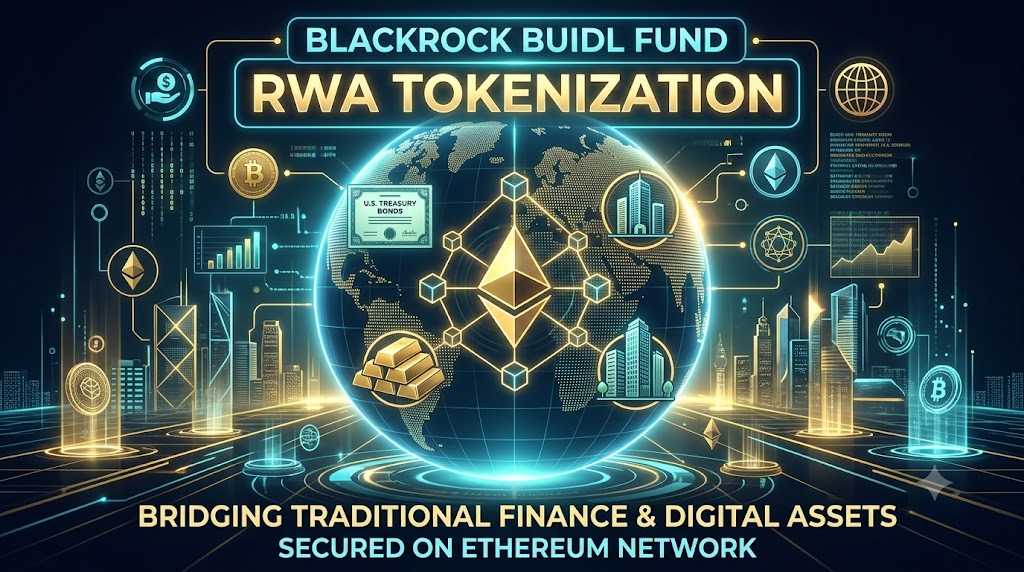
RWA tokenization is rapidly transforming the global digital asset ecosystem, led by institutional milestones like BlackRock’s BUIDL fund. As traditional finance titans like BlackRock, Fidelity, and Franklin Templeton accelerate their on-chain deployment, real-world asset tokenization—spanning government bonds, private credit, and real estate—has scaled into a multi-billion-dollar market sector.
In particular, BUIDL (BlackRock USD Institutional Digital Liquidity Fund), launched in partnership with Securitize, has driven historic inflows into tokenized short-term US Treasuries. This institutional wave is shifting the broader crypto ecosystem away from retail-driven speculative cycles toward sustainable, yield-backed digital settlement rails.
In this guide, we break down the fundamental mechanics driving the RWA tokenization BlackRock BUIDL market, compare the top tokenized treasury products, and evaluate strategic opportunities for long-term crypto investors.
1. RWA 1.0 vs. RWA 2.0: The Evolution of Asset Tokenization
While the early “RWA 1.0” phase focused primarily on illiquid fractional investments in niche real estate or luxury art, today’s RWA 2.0 era centers on institutional-grade, risk-free base yield assets—specifically US Treasury bills and high-grade cash equivalents.
Core Structural Benefits Driving RWA 2.0 Adoption
- 24/7/365 Atomic Settlement: Traditional financial markets rely on legacy settlement cycles (T+1 or T+2) and strict market hours. On-chain tokenization enables instant, round-the-clock transferability and finality across global blockchain networks.
- DeFi Collateral Integration: Tokenized yield assets like BUIDL and Ondo’s USDY are increasingly accepted as prime collateral in decentralized lending protocols and derivative exchanges, allowing capital to earn risk-free baseline treasury yields while simultaneously unlocking on-chain liquidity.
- Automated Yield & Lower Administrative Friction: Smart contracts handle token rebalancing, daily yield distribution, and dividend payments, dramatically reducing custody overhead and intermediary costs. For fundamental details on network standards, review official developer documentation at Ethereum.org.
2. Comparing Top US Treasury Token Funds: BUIDL, FOBXX, and Ondo
The institutional RWA landscape is currently dominated by short-term government debt instruments. The three leading players establishing market infrastructure include:
Key Market Competitors
- BlackRock BUIDL (Ethereum & Multi-chain): Issued via Securitize on Ethereum and expanding across major Layer 1 and Layer 2 chains, BUIDL offers institutional investors continuous yield accrual, 1:1 USD peg stability, and seamless collateral utility.
- Franklin Templeton FOBXX (FOBXX Token): One of the earliest traditional asset managers to integrate public blockchains like Stellar and Polygon as official transfer agency recordkeeping systems for a money market fund.
- Ondo Finance (OUSG & USDY): A pioneering protocol bridging institutional liquidity with decentralized finance by offering tokenized short-term US Treasury exposure (OUSG) and yield-bearing stablecoin alternatives (USDY).
3. Comparison Table: Traditional Assets vs. Tokenized RWA 2.0
To highlight why institutional issuers are adopting RWA tokenization BlackRock BUIDL models, the table below compares traditional asset management against on-chain RWA 2.0 infrastructure:
| Feature Parameter | Traditional Financial System | On-Chain RWA 2.0 (e.g., BUIDL) |
|---|---|---|
| Trading & Transfer Hours | Standard market hours (Mon–Fri, non-holidays). | Continuous 24/7/365 global transferability. |
| Settlement Speed | T+1 to T+2 clearing delays via clearinghouses. | Near-instant atomic settlement via smart contract. |
| Collateral Re-hypothecation | Opaque, manual margin and credit operations. | Transparent, smart-contract-verified DeFi collateral use. |
| Operational Overhead | High intermediary and management fee structures. | Programmatically automated distribution & compliance. |
4. Strategic Ecosystem Takeaways & Investor Outlook
As major financial institutions transition billions of dollars onto blockchain networks, retail and institutional participants should consider the following strategic takeaways:
- Sustained Demand for Layer 1 Settlement Infrastructure: Issuance of security tokens on networks like Ethereum reinforces long-term demand for ETH gas fees, security staking, and ecosystem Total Value Locked (TVL). For broader crypto market coverage, explore our latest market insights.
- Permissioned vs. Permissionless Yield Assets: Compliance rules (KYC/AML) are strict for institutional vehicles like BUIDL. Investors must distinguish between whitelisted institutional shares and permissionless, yield-bearing stablecoins available in broader DeFi markets.
- Focus on RWA Infrastructure Middleware: Long-term value accrual will increasingly concentrate in cross-chain messaging tools, decentralized oracle networks, and compliant identity verifiers powering on-chain asset management.
💡 Summary and Conclusion
The rapid expansion of RWA tokenization BlackRock BUIDL initiatives demonstrates that blockchain technology is solidifying its role as the next-generation settlement layer for institutional finance.
By digitizing US Treasuries and expanding into private debt and credit markets, real-world asset tokenization bridges global liquidity with decentralized efficiency, opening unprecedented opportunities for digital asset markets.